There appears to be a madcap energy subjugating comedy films right now. If modern romcoms largely fail in their attempt to revive the comforting glow of their 2000s counterparts, modern comedies seem to be gleefully harkening back to the 1980s school of slapstick hyper-absurdism.
Real ridiculousness needs no introduction today, but it needs a re-introduction to the better cinema of yesterday.
Take the wall-to-wall gag machine of last year’s The Naked Gun legacyquel, whose blessed 85-minute runtime conjured its ’80s predecessors just as much as its signature unabashed silliness. Far superior and far less seen was Splitsville, a Neon release focused on a love quadrangle where two, let’s say, unprepossessing men somehow appeal to the likes of Dakota Johnson and Adria Arjona. The film, while featuring peerless screwball moments like bags of fish flying off a rollercoaster and a cutaway shot to a flaccid penis, also somehow manages to incisively comment on the transience of pleasure and relationships.
The throw-everything-at-the-wall looseness of these films belies a surprising auteurism. Say what you will about Liam Neeson getting handed a coffee cup every ten minutes, or that spit-take-inducing dick shot: Recent comedies boast both a wildness that meets the genre’s mile markers and a deft craftsmanship that fuses stupidity with charm. If it manages to also *scare quotes* say something, the film achieves a rarefied air elevating it far above the genre’s typical disposability.
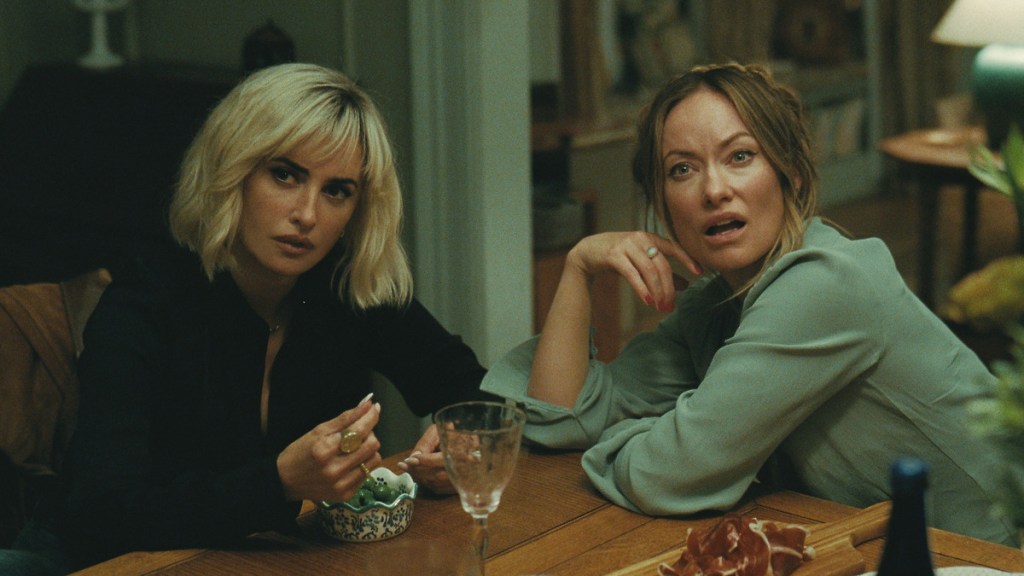
The Invite is by no means one of those gag machines. On its face, it reads more as a dramatic hypno-wheel of mind-fuck than the smartly deranged comedy it is. Director Olivia Wilde stars as Angela, wound tight from a hellish San Francisco renovation, who one day decides to pick up some wine and cheese to celebrate the finish line, I guess. That’s any husband’s dream, apparently, unless you’re Joe (Seth Rogen), her miserable failed-rockstar husband stuck, in his own mind, outside of the happy existence that should be waiting for him, whatever that may be.
After he barrels intolerably into his own apartment, back spasms and all, he learns this wine and cheese was not for him: Angela spontaneously invited the hot sexy couple upstairs over to “check out their renovations.” Joe hates this; he hates any kind of social situation he has no control over. Angela knows this, and maybe relishes in it. The couple in question, Hawk (Edward Norton) and Pína (Penelópe Cruz), enter with élan but hesitation.
Anxiety flows forth and plumes like wine poured and joints smoked. Hawk and Pína want to fuck them, but Angela and Joe are in their own rotten world. They wish their world were Hawk and Pína’s, full of freedom and healthy communication and loud noise originating from love rather than hatred. When Angela and Joe are granted entry into that world, their trepidations and resentments, past and present, blockade them.
Is it Who’s Afraid of Virginia Woolf ? Only in setup, but not in execution. These actors are here to play, and you can sense the improvisation in places. Will McCormack and Rashida Jones pen a cutting script, but the four leads are so on fire in moments you can feel improvisation creeping through the frame. Grounded, quiet beats shape into volcanic interrogations, almost to the point of surrealism; how the fuck did we get to this point where these people are talking about the things they’re talking about?
It doesn’t work at all without Rogen. He has never been this simultaneously in the pocket and out of his comfort zone, shoved in a corner, weird and cringy, playing total anxiety with a profundity and ferocious humor that displays a totally new toolbox. Sharp as a tack, quick with a joke or a light up your smoke, yet totally dead inside. Misery with a salt-and-pepper beard. Danny Boyle and Spielberg have cited him as great with lines, a quick study, but he flaunts an incredible facility for timing within wickedly dramatic moments. Rogen’s arc is all the more singular when you consider he’s largely driven his own material since his early 20s (I crave the brilliance of him at a mere 25 co-writing and directing Superbad, a generational classic similarly rooted in the trauma of falling sideways in front of the person you think you love). Rogen and Wilde are mesmeric together, conjuring Rogen’s passive aggression that plays and folds into the media anxiety of Wilde’s off-screen persona and creates tasty, tasty acid. That episode of The Studio was merely preamble.
Norton and Cruz antagonize with overwhelming allure, knowing exactly when to deploy their sexual control. When you consider Ed Norton performances, you envision the opposite of control, a man drowning in his own mind about how his performance should out-kick and often conflict with his director’s vision. Here, the self-serious Baltimore native gives his best performance in years, swinging all the way in the other direction to provide uncut, joyous watchability. Cruz matches his freak without flaw; since winning the Oscar for Vicky Cristina Barcelona, the actor has played a run of characters whose superpower is knowing how to invoke devastating instability among all men within earshot. She is a Dutch angle of an actress, her beauty and presence tilting the mood ever so slightly until everyone else in the scene is forced to overreact in some way.
Comedies should always feel like they’re flying off the rails. They should be fearless, insane, unsafe. It’s unfairly ignored in this way, but the comedy genre has offered, over its more than 100-year history, many of the greatest films ever made. There’s never been any virtue in making one that is safe. If the studio comedy is to be saved not just at the box office but from that aforementioned bin of disposability, then each one should show, from the jump, that safety is not guaranteed.




Leave a Reply