I call this the death rattle. The franchise machine of the last 15 years, if we consider it human for a moment, is now passing its last breath and coughing up sputum. It is recounting its regrets to a bedside priest while a wave of calm death washes over with awesome relief.
This franchise machine’s brain, as it shuffles away from the nightmare of existing on Earth, now floods with naturally recurring DMT, inducing the sensation colloquially known as “life flashing before your eyes.” I think Avengers: Endgame would be the longest flashing moment.
We are all tired. Public exhaustion from studio mediocrity led us all the way in the other direction toward YouTubers, now Hollywood’s most profitable enigma of the year. Live-action remakes like Moana have been rebuked by critics and, even better, ignored by audiences. Marvel has been enshittified. The feeling in the film world seems to be that no one wants mindless, pandering junk anymore. We want events, substantiated and legitimized by smart authors who fought to push the boulder that is their painstakingly crafted project up the hill.
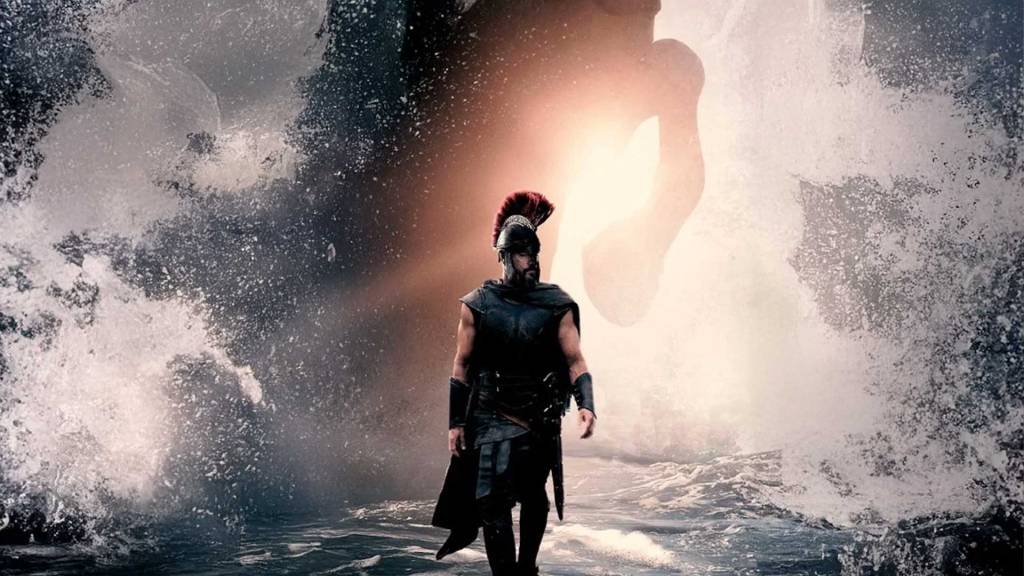
The Odyssey bulldozing through the world, the box office, and the global culture this weekend is the apex of this sentiment we’ve been excitedly grasping at for months now. If Obsession is the mousy example of the Internet’s fiendish — I have to do it — obsession with auteurs and box office, The Odyssey is the stalwart lighthouse that feels like it’s been there much longer, drawing everyone else to shore. It is the latest breathless feat of several breathless feats from one man whose films and name alone have defined a generation. We go to a Christopher Nolan film seeking an experience: the culmination of five senses in one art form, obliterating all of them at once, stopping the popcorn an inch from your mouth because you can’t breathe, raising the hairs on your arm, bold reminders you shouldn’t pay $20 to go to the theater for just anything. If I don’t smoke a cigarette to decompress after a movie, it’s probably not a Nolan movie.
His closest comparison, I guess, is Kubrick, though his oeuvre largely benefits from decades of distance. In units of scale, grandiosity, budget, intellect, culture-devouring hype, and Letterboxd apotheosis, Nolan movies are Immediately Important. Despite his endless infatuation with the passage of time, his films don’t need it. He occupies a space even Spielberg has never: Both directed lengthy, black-and-white World War II dramas that won Best Picture. One grossed $960 million, the other made a third of that. Would you believe me if I told you the director of Jurassic Park and Jaws was the loser?
More impressive is Oppenheimer’s win occurring in the age of streaming services, endless options, disposable claptrap. New movies and shows now constantly compete with every movie and TV show that has ever existed. When we sit down and boot up our TV, we are peering into a fully stocked fridge, anything and everything we want at our disposable. Our media diets are bound by nothing. Still, Oppenheimer, three hours of people mostly talking in rooms, made nearly $1 billion in a post-COVID environment allergic to the theatrical experience. I could’ve rewatched The Office again and been happy. I went and saw Oppenheimer a third time instead.
It’s because Nolan is incapable of making anything but a set piece. Pacing, adrenaline, and theme coarse through every loud and quiet moment of Oppenheimer and The Odyssey; they may be the most symmetrical movies of any director’s filmography. Both portray a man – one imprisoned by his own vigor, brilliance, and quiet rage toward the structures he’s stuck in – destroying civilization. Nolan frames it as a civilization, the movie’s idea of it, but it’s inherently our civilization, our one world we all currently live in and despise but have to endure because everyone else is getting in our way and making the wrong choices. Every great man who has thrust us forward, whether in mythology or reality, has decimated the fabric of how we live despite themselves. They earmark our place in the large, flawed mosaic of time. The Odyssey is another giant monolith from a director obsessed with the nature of man; there’s a reason Kubrick included “odyssey” in the title of his masterpiece on monoliths.
Nolan is also an artist of many masterpieces – I almost want him to shout “COUNT THE RINGS, BITCH” when he fields a question about casting controversies – but it’s likely we’ll never see anything like The Odyssey again in Hollywood. Despite topping himself before, this can’t help but feel like a ceiling. The man could film someone breezing a phone book and Universal would still back up the Brinks truck to his front door in Knightsbridge or wherever. He could adapt the Bible, I guess, but not even his blank-check status could get that over the line with studios; religion induces violence, Homer’s epic does not. He could revert to an ingeniously original mind-fuck like Inception, but would that be a step down? Would that propagate his own one-upsmanship that inevitably stems from adapting a known property?
He is undoubtedly the single most powerful and bankable person of 21st century art, making the most powerful and bankable art of the 21st century. The question rests on how he can go bigger better – or, more interestingly, go smaller better. We could wake up to an announcement that he wants to do a three-person play on the West End. It wouldn’t make a full yard, but it’d definitely be interesting. Maybe he transmogrifies another medium to his will, the way Circe turns men’s faces into pigs. Maybe he wrestles and subjugates something like the theater the way he did with cinema. If you were this dominant, wouldn’t you want to conquer all in a cunning and ridiculous way? He doesn’t even need a Trojan horse. He can simply be himself.
The diamond-cut craftsmanship of The Odyssey indicates he has done everything he can with movies as art. If he can top it, we’ll surely be waiting again in the blood-soaked queue of the AMC app. His next project will most certainly be a level up, one way or another. He’s incapable of going anywhere else.





Leave a Reply